Sunday, June 24, 2012

Cabirma, Pozo Prieto, Cabia


So much has happened the last 2 weeks it is difficult to believe it has only been 2 weeks.  We are writing this 24 June 2012.

                                                                             Figure 169  Family Vehicle

We visited the branch in Consuelo and attended their meetings on Sunday.  This is a little branch about a 2 hour drive in a eastern direction from our home a new area for us.  The branch president is a young return missionary doing a monumental job against great odds.  We explained to him how we as humanitarian missionaries could help him help the poor in his area. The above picture is pretty typical—not an exceptional thing.  This is a family on their way home from church.  The dad took the kids home, then came back for mom and the little girl. 

                                                              Figure 170  Pres. Almonte and Elder Haws

During the week we drove to Santiago about a 3 hour drive to the north to attend an event where we donated some things to a Catholic Orphanage.  On the way another car clipped our front bumper and kept driving.  Pres Almonte gave me a metal clothes hanger and we were able to wire it back together.  The next week I backed into another car and caved in the back door.  We lost the day hunting up the owner and then going with him to the police station to report the accident.  That is how things are done here  On the way home from Santiago, Edith bought a colorful rug from these ladies.
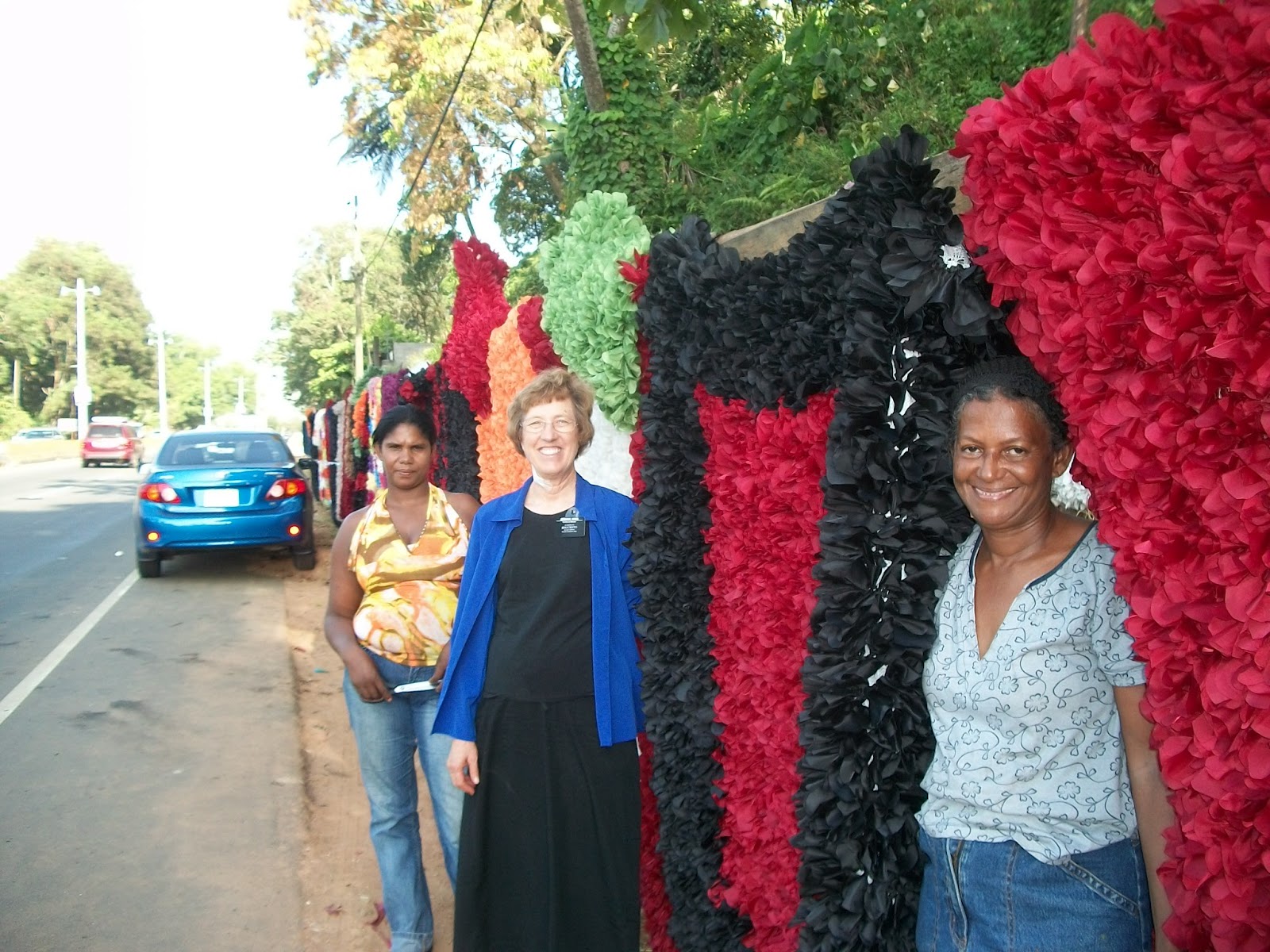
                                                                                               Figure 171  Carpets

                                                            Figure 172

It is common to see people sitting on chairs in front of their houses or on the sidewalk playing dominoes, the national past time.

We took the time on a Monday to go on a short excursion with Dennis and Diana Despain.  We went to tourist shop where Edith bought a ring made of laramar and we toured Bolivar park.

The Despains are temple works and do not have a car assigned to them, so they are appreciative of us scheduling our time once in a while to take them places.  The have a pretty standard routine every week with specific assignments and days they are to work.  On the other hand we make our own schedule and do whatever we want, when we want with our own car. 

                                                                 Fig173 Fig 174

Later in the week we drove 4 hours north to Puerto Plata.  We visited one of the popular spots on the island, the Teleferico.  It is a cable car that takes you to the top of a high mountain to where a statue of Christ has been constructed at a beautiful over look point of the bay far below.


Fig 175


Fig 176


Fig 177

The reason we drove to Puerto Plata was to discuss a water project in 3 little communities:  Cabirma, Pozo Prieto and Cabia.  This is a project started by the previous missionaries.  Following the pattern we established on other projects, we involved the stake president immediately at the beginning of the project.  He called a meeting for the mayor of the community, members of the water committee, a contractor and a representative of CARITAS a Catholic Charitable organization and us to discuss and plan the project.  The stake president took charge, conducted a wonderful meeting that was very productive.  The following picture is of the committee put together for the project.

Fig 178


Fig 179

After the meeting at the church house, members of the water committee to us to visit the proposed water project site.  Our first visit was to see a pump the church has installed 10 years ago.  It is still working fine.  There were people that used the pump while we were there.  As we learn more about the project, we will need to determine how many people are using the pump and what the current conditions are.  It doesn’t make sense to spend money on a location that has water when other locations are suffering much more. 


In another part of town they have an electrical submersible pump that supplies part of the community with water.  They have no tank so they turn the pump on for 3 hours every other day.  When the pump is running people open a water tape that allows the water to run into a small tank in each home.  Well their individual tank is full, they turn the tap off and those higher on the system can fill their tanks.  The families have to make it last until when the pump is turned on again. 


Fig 180


Fig 181

The committee drove us to the top of a little knoll where they envisioned installing a new water tank.  Throughout the trip Wallace was taking readings with his GPS unit to determine location and elevation for the important locations of the project. There turns out to be only a few homes who have absolutely no easy water supply. These people have to haul all their water and purchase clean water with a huge percentage of their monthly income.


 The last location they took us to, we had a very big surprise.  There stood a large concrete water tank about 40’ square.  The committee explained it had been installed by the government 10 years ago.  There were no pipes to it and no pipes leading from it.  We didn’t explain to them or try to show our astonishment at this discovery.  Wallace is absolutely sure there is a detailed water study someplace justifying the expense to install such a large water tank.  The water committee is ignoring the existence of this perfectly good water tank and intending to install a completely new one. 


It seems to us that we are finding that many of the humanitarian projects implemented in the past were done on a whim without a thorough examination of costs, options, or social impact or need.  In this case, the prior missionaries we advancing rapidly to do whatever the citizens wanted without requiring community involvement and without examining thoroughly.  We discovered when we returned home and entered the GPS points into our program that the existing tank is actually the highest point in the system, so there doesn’t make any sense to install a new expensive water tank.  We assigned a member of the water committee to go do the research at the government and find out what the water service area was for the tank.  The overall cost of the project will be greatly reduced is all we have to do is run a little bit of pipe to the new tank.


We are reminded over and over that these projects are “Social” projects more than anything else. 


Fig 182


This week the Kelvyn and Kaye Cullimore, Short Term Specialist came to spend the week with us.  They are responsible for the Food and Wheelchair Major Initiatives in many parts of the world.  We visited a lot of places as part of their stop here on their way to Haiti.  We visited more places than we can recount as we inspected our wheelchair partners and discussed a Food Initiative with several small branches of the church in San Juan de La Maguana, Azua, Bonao and Santo Domingo.  We also visited the Ministry of Agricultural to see if we could partner with them to start some projects.  We found out they have a lot of resources including free seeds.  They showed us an elevated box they designed that people can put on top of their roofs if they do not have any garden at their homes


Fig 183


Fig 184

We visited with a branch president of a little congregation who had had chickens at one time.  His experience is demonstrative of the reason why we have decided not to include chickens in this first food project.  He has no job.  Somehow he scraped together enough money to buy 20 chicks.  He raised them to the point they were laying eggs.  Then every time one of his members came to the house and asked him for an egg, he would let them rob the coop.  His family rarely got to eat any eggs.  One by one his family ate a chicken until they were all gone and he had no more chickens.  That is exactly why we don’t want to spend a bunch of money on chickens until we can figure out how to control the project.  We decided to stick with gardens because they are less complicated.


Fig 185

We are getting calls from all over the place about the food project.  Here we are considering the possibility of using land owned by the church for a community garden.  There are so many social problems associated with it, I have little hopes this kind of project would ever be approved.


Fig 186

As part of our wondering around we took a short detour and visited a Church camp in Bonao.  The next few pictures are of the camp.  We were totally blown away.  How is it possible the church spent this kind of money in a poverty stricken 3rd world country like the Dominican Republic? 


Fig 187


Fig 188


Fig 189


Fig 190

Sunday, June 10, 2012

SURGERY

Edith experienced surgery in the Dominican Republic this week!  But we will reserve that report to the end of this week’s report to keep your attention.

We drove to the “Parque Mirador del Sur” to do our morning walk.  It is a long skinny park with running and biking trails that is very popular.  We wanted to visit the park for the fun of it and to test our the GPS unit Wallace is planning to use on the water projects.  Wallace concluded it is find for horizontal, but is way off vertically.

                                 
                                                                  Figure 152 Edith at Mirador Park

                                                             Figure 153 Curb and Gutter construction

All you civil engineers out there will be interested in the sub-base used for this curb and gutter construction.

Last Sunday we took the Despain couple with us to visit the wards in Bonao (about a 1.5 hour drive north of Santo Domingo) and then to visit the “Hogar de Ancianos” an old folks home.  Wallace had taken his Ukulele, which Elder Despain played while we sang “Amazing Grace” and “I am a child of God” to the residents.  The Hogar de Ancianos is a home for old people run by 4 little Catholic Nuns.  They are doing a marvelous work.  We provided them with some equipment they needed.

                                                   Figure 154 Despains and Haws' singing with Ukulele

                                                     Figure 155 Edith greeting some of the residents
We had a wonderful visit at the Hogar de Ancianos and once again reminded us of the many people of all faiths who see a need in their community and don’t just talk about it, but do something even without support of the government.  One of the nuns pulled out her guitar and they sang for us before we left the home.  It was a very special occasion that touched our hearts.

We also went to Alcarizzos to visit CONANI.

The following picture is of the ward committee that was organized by the bishop in preparation for our visit.
                                
                                                      Figure 156 Los Alcarrizos ward committee

                                                                              Figure 157 Huelga

We experienced our first “Huelga” on the way to CONANI.  It was a street riot.  We don’t know what they were rioting about, but we were glad we were in our car, even though we were stuck in traffic right in front of them for a little while.

                                                                   Figure 158 CONANI School
CONANI is a school established to take in children who have terrible home situations.  They teach them and feed them and then send them home at night.  They are doing a wonderful work.  The ward committee is putting together a project to include some play equipment for the children and to fix the bathrooms which do not flush.  It was a pretty ugly scene there!

                                                             Figure 159 Street Meat Vendor

                                                         Figure 160 Man sleeping on the sidewalk
It is not uncommon to see homeless men sleeping on the sidewalk.  It really pulls at your heart strings.

                                                          Figure 161 Via Verde Mother
We visited a place called Via Verde this week.  It is by far the poorest all anywhere we have visited so far.  The people mostly live in wooden shacks with tin roofs and dirt floors.  Most do not have any electricity and few have any running water. 
                                                                     Figure 162 Little girl in Via Verde

                                                            Figure 163 Edith, children and Wallace
This is a land of extreme contrasts.  What was our surprise to also see this house under construction in Via Verde!

                                                     Figure 164 Three Story house in Via Verde

                                     
                                                          Figure 165 Dominican Scouts Headquarters

                                                                  Figure 166 Guard with chicks
Our guard is taking a phycology class on Saturdays.  During the week he is learning about human nature as he studies his chicks and trying to teach them tricks!

Now we will tell you the story about the surgery!

June 10, 2012:  About two and a half weeks ago Edith noticed a bump on her neck.  At first she thought it was an infected mole, but it was hard and never came to a head.  Also it started growing larger. After consulting the area medical advisor and a dermatologist from the States (over the internet), Edith was off to get it biopsied. Luckily there was a Dermatologist by the name of Jaime Martinez, who had an office within walking distance of our apartment.  His name was listed on the Bluecard Worldwide Medical guide.

  After touring medical facilities in the country, Edith was a little apprehensive at first, but when Dr. Martinez walked in his one room office with a simple ceiling fan overhead, he was very confident and immediately recognized the growth as a “Queratoacantoma” (Keratoacanthoma in English).  This just so happened to be one of the possible diagnosis that the dermatologist in the States had given. Dr. Martinez said the growth had to be biopsied, in fact he said he would remove the whole thing.  Edith was in surgery the next day.  The surgery center was next door to the doctor’s office. 

                                             
                                                                 Figure 167 Dr. Martinez and Edith

Surgery is different in the DR than in the USA.  The doctor performs surgeries every day at 3 p.m.  No waiting.  Dr. Martinez was there to personally escort us back to the operating room.  One operating room and one changing room is all there was.  The equipment was adequate and clean.  No recovery room was needed.  When finished the doctor personally escorted us back to his office to pay, then handed us a jar with the growth in it to be taken to the pathologist.  We walked across the street to the pathologist and paid him.  Then walked to the pharmacy to get antibiotic and pain pills, then back to the surgery center to pay our bill.  It was all completed in a little under three hours.  No hassle, just paid in cash.  The pharmacy even hands you back your prescription and sells the pain pills by the pill, you just say what you want, come back if you need more.

The walk to the doctor was easy enough.  A car would have been in the way as it is very difficult to find any parking.  In reality we paid a lot less than this kind of procedure would have cost in the States.  We paid a total of $15,000 Pesos or about $390 US which includes, Doctor, Surgery Center, Pharmacy, Pathologist and follow up visits.

                                        
                                                                          Figure 168 Edith's Stitches
The results were received three days after surgery.  It was indeed a Keratoacanthoma, no cancer.  Stitches to be removed ten days later and a follow up visit in a month, are all included in our payment.

Saturday, June 2, 2012

San Joaquin and Los Americanos

It is hard to believe we just finished our 8th week in the Dominican Republic.  In spite of our trials and challenges, we love it here and are having the greatest adventure of our lives!  This week was no exception.  The highlight of our week was our visit to the San Joaquin Escuela and the Hospital commonly known as “Los Americanos”.  We continue to be impressed deeply by the conviction and life dedication of Dominicans of means to relieve suffering among the poor.  We take so much for granted in the United States and are quick to grumble and complain if the slightest thing goes wrong or if someone encroaches on our space or sight or hearing.  Our experiences this week left us very humbled because we have seen the face of the suffering Christ and the hand of God mightily upon the people of this land.  We have no doubt God’s hand is working in so many ways among this people and we personally have felt His arm upon us guiding, teaching and making us better instruments in His hands.  We are having an adventure in following the Light of Christ.  What a unique and powerful blessing it is for us!  We wish we could adequately explain it.

                                                              Figure 139 Youth doing service
This young man goes every Sunday to pick up this older gentleman for church.  We arrived in time to go get him in our blue car which helped him a lot.  They were both so appreciative.

SAN JOAQUIN ESCUELA

We learned that all public schools here in the Dominican Republic are marked in distinctive colors.  The students everywhere wear light blue shirts.  The vertical and horizontal members of the exterior fence of schools are always painted yellow.  The fence panel is left plain grey block.  The exterior walls of the school itself are always painted yellow and the interior rooms are green or a combination of yellow or green.  The yellow and green match the color of the cross and the green the branches on the Dominican Flag.

                                                                    Figure 140 School Children

Our project with the School started with a request to us from the bishopric of the ward to buy paint for the school.  We visited with them about welfare principals and the importance for members of the ward to learn leadership and experience a practical application of these principals.  As a result they took the request back, called a specialist and arranged a meeting with the school and us.  This process is working beautifully!  The members are excited.  The school administrator got excited, called members of the school board to be part of the committee and contribute in positive ways—so the parents are now involved.  The local ward members took charge of the meeting, began with a word of prayer and developed a wonderful project.  We hardly participated at all---exactly what should happen. 

As we toured the school we suggested the project be expanded a little bit to include a repair of the fence and repair of the bathrooms that haven’t worked for a very long time. 

As we were discussing the project, they asked us to explain what we do in the country and the type of projects we work on.  They were very moved and appreciative of what we do.  They spoke of their own efforts to relieve suffering among their people and were nearly brought to tears as they spoke of their own experiences.

As we were standing around the flag pole at the close of the session, I was suddenly struck with the inspiration that the children should be involved in the project somehow.

                                                                    Figure 142 School Committee

 I suggested to the school director and parents that the children be told of the miracle about to develop at their school and there was going to a “renewing” of the school, school spirit and hopes for the future so the children would have the opportunity to prepare a program of singing and talents.  Then when the children are on vacation, we will have a contractor come fix the fence, a plumber to fix the bathrooms and the parents of the school and the youth of the local ward will paint the building.  When the children come back their school will have received a new face lift which they will celebrate with singing and talents.

                                                          Figure 143 San Joaquin Classroom
 We did not tell them, but we intend to invite the mayor of the city to the program so he can present them a new Dominican flag that we buy for him to present to the school for their flag pole.  We will see how things develop in reality, but none of it would have happened if we had not proceeded as we were inspired.

                                                                     Figure 144 Sister Perez and Edith
The Perez family showed us around the neighborhood.  The following are a few street scenes. 

                                                                    Figure 145 Horse fruit cart

                                                                  Figure 146 Street Vendor

                                                                        Figure 147 Garbage Truck
There are designated places throughout the city where people understand they are to dump their household garbage on the sidewalk where the garbage men will eventually come by to pick it up.  Nobody pays them any mind.  This one happens to be right across the street from the ward building in San Vicente where the San Joaquin school is located.

Note the plastic bottle recycle operation on top of someone’s house in the following picture. 

                                                              Figure 148 Street scene in San Vicente
The Perez family served us lunch of “La Bandera” (rice, beans  “habichuelas” and chicken) in their home before we left.  We get nervous eating in people’s homes, but we cannot refuse without being rude.  Sister Perez loves Edith and always made sure there was a flower in Edith’s hair.  Several times Edith was alone with Sister Perez.  Edith couldn’t understand much of what was said, but that didn’t stop the living conversation!

                                                       Figure 149 Lunch of La Bandera with Perez family

LOS AMERICANOS HOSPITAL
 Centro Cristianos De Servicios Medicos, Inc. was started by William Hunter as a Christian humanitarian missionary, as a service to the poor in the Dominican Republic in 1970 with his friend John Shannon. (The hospital became known as “Los Americanos” because they were US citizens).  They provided lenses and low cost care for vision problems.  In 1979 the home they used for their clinic was completely destroyed by hurricane David.  William Hunter decided to permanently moved to the Dominican Republic and to build a more permanent structure.  In 1985 with a land grant from the government, the Los Americanos Hospital Dr. Elias Santana was built in Los Alcarrizos.  They now have several centers throughout the Dominican Republic that offer low cost Vision care to the poor. The facilities also serve as a Graduate School in ophthalmology for theUniversidad Nacional Pedro H. National University Pedro H.Ureña y centro de entrenamiento para nuevas carreras de Urena and training center for new careers in eye care, surgical assistants, nurses and five surgical specialties in ophthalmology. asistencia oftálmica,asistentes quirúrgicos,enfermeras de cirugía y cinco especialidades de laThe hospital is comprised of doctors who donate one day of the week and operations for patients in their specialty.para atender y operar pacientes dentro de su especialidad. Thisoftalmología. specialization program is considered one of the bestformación en oftalmología en América Latina. training centers in ophthalmology in Latin America. Last year they saw 80,000 new patients.  The Hospital currently services about 600 patients a day.
                                                        Figure 150 Doctor at Los Americanos Hospital
We were able to complete a project the Church had started with the hospital before we arrived by delivering some delicate vision equipment to the hospital.  It was a choice experience for us.  We saw hundreds of patients, patiently waiting their turn.  It was amazing to recognize they do indeed service as many as 600 patients a day.  They operate on a shoestring budget with mostly faith that each day things will work out—and they do.  They spoke of their faith in God and the guiding hand of Christ in all they do. 


     Figure 151 Master Surgeon by Nathan Greene

They operate on the principal of accountability and self-sufficiency.  Each of their doctors donates a full day each week.  They do not turn anyone away who cannot pay, but everyone pays what he can.  Again we were humbled by their circumstances.  We concluded we will be happy if we can have just a small little corner in the same heaven where they will receive their just reward of a crown of glory in the next life!  We have not seen anything like this in the United States where so many people in so many places wear out their lives in the benefit of their fellow men to relieve suffering wherever it is found! We are truly blessed to be here!